

Quick answer: You cannot move a UK limited company’s registration to Dubai. You have three options instead: register a branch of the UK company, form a UAE subsidiary owned by the UK company, or form a new UAE company that you own personally. A branch keeps the UK name. A subsidiary limits liability. A personal company sits outside the UK group. (Checked November 2026.)
Most UK owners ask this question when Dubai clients start asking for a local invoice, a local office or a UAE trade licence. The answer shapes your liability, your UK and UAE tax and how fast you can trade, so it is worth choosing deliberately. This guide sits within our wider business setup in Dubai guidance, and Gatestone Group has teams in London and Dubai who handle both sides of the process.
Your three options at a glance
| Branch of your UK company | UAE subsidiary owned by your UK company | New UAE company owned by you | |
|---|---|---|---|
| Separate legal entity | No, it is part of the UK company | Yes | Yes |
| Liability | UK company liable for all branch debts | Limited to capital invested | Limited; UK company not exposed |
| Ownership | 100% UK parent | 100% UK parent (mainland or free zone) | 100% you as an individual |
| Activities | Must match the UK company’s business | Its own licensed activities | Its own licensed activities |
| UAE corporate tax | Taxed as a permanent establishment of the UK company | UAE resident taxpayer | UAE resident taxpayer |
| UK tax | Branch profits taxed in the UK company unless exempt (see below) | Dividends to the UK usually exempt; CFC rules can apply | Outside the UK company; your personal UK residence matters |
| Indicative first-year cost | £2,600 to £24,300 | £2,500 to £10,100 (Dubai free zone) or more on the mainland | Same as a subsidiary |
| Banking | Bank asks for UK parent documents and resolutions | Bank asks for UK parent documents and resolutions | Bank asks for your personal documents |
Costs are indicative, drawn from published market prices in November 2026, and vary by activity, visas and office space. See the cost section below.
1: a branch office of your UK company
A branch office in Dubai is your UK company registered to trade in the UAE. It has no shareholders of its own, so contracts are signed by the UK company and its full balance sheet stands behind them. You can register a branch on the Dubai mainland or in a free zone.
Mainland branch
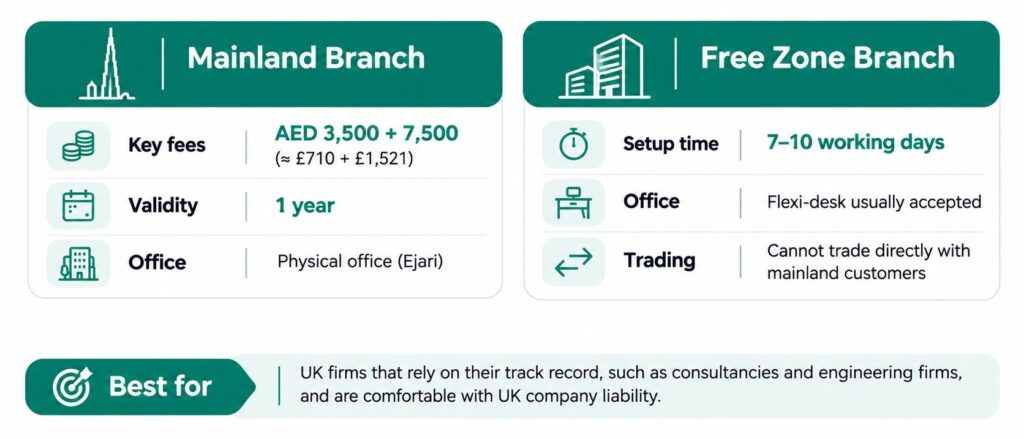
You need a trade licence from the Dubai Department of Economy and Tourism (DET) and registration with the UAE Ministry of Economy. Under Ministerial Resolution No. 138 of 2024:
| Ministry of Economy step | Fee | Rule |
|---|---|---|
| Initial approval | AED 3,500 (about £710) | Valid for 8 months |
| Registration | AED 7,500 (about £1,521) | Certificate valid for 1 year |
| Deadline | Register within 1 month of the local licence | |
| Late registration | AED 100,000 fine (about £20,280) | |
| Auditor | A Ministry of Economy registered auditor must be appointed |
The resolution removed the old AED 50,000 bank guarantee. Since 2021, a branch of a foreign company no longer needs a UAE national service agent, according to the official UAE government portal (u.ae). Some older guides still say it does, so check any professional activity licence with DET. A mainland branch also needs a physical office registered on Ejari, Dubai’s tenancy system.
Free zone branch
ree zones such as DMCC and JAFZA register branches of UK companies directly. DMCC quotes 7 to 10 working days once your documents are complete. Free zones often accept a flexi-desk, which keeps costs down. A free zone branch generally cannot trade directly with mainland customers without a distributor or a mainland licence. Our guide to free zone vs mainland for UK entrepreneurs covers that trade-off.
A branch suits UK firms whose track record wins the work, such as consultancies and engineering firms, and that are happy for the UK company to carry the risk.
2: a UAE subsidiary owned by your UK company
A subsidiary is a new UAE company, a free zone company (FZ-LLC or FZCO) or a mainland LLC, with your UK company as the shareholder. Since 2021, foreign owners can hold 100% of a mainland LLC for most activities, apart from a short list of strategic activities.
Because the subsidiary is a separate legal person, a claim against it stays in the UAE and the UK company’s exposure is limited to its investment. The subsidiary has its own licence, its own activities and its own UAE tax registration. It can also take in a local partner or investor later, which a branch cannot.
On the UK side, dividends the subsidiary pays to your UK company are usually exempt from UK corporation tax. The UK controlled foreign company (CFC) rules can still tax some profits of a UAE subsidiary, although exemptions apply, for example where profits are below £500,000 and non-trading income is below £50,000. Our post on UK tax implications of a UAE company explains this in more depth.
3: a new UAE company owned by you
You can also leave your UK company out and form a UAE company in your own name. This suits founders who want a separate UAE business, perhaps with different clients or activities, or who plan to relocate.
The UK company is not involved, so its accounts and liabilities are unaffected. Your personal tax position then matters. If you stay UK resident and run the UAE company from the UK, HMRC may treat the UAE company as resident in the UK. Our guide to running a UAE company while living in the UK sets out how to manage that risk.
What happens to your UK company if you move to Dubai?
A company incorporated in England and Wales, Scotland or Northern Ireland stays UK resident for tax, wherever its directors live. HMRC’s International Manual confirms that the incorporation rule applies, and central management and control matters mainly for companies incorporated outside the UK.
If the UAE also treats the company as resident because it is managed there, the UK-UAE double tax treaty has no automatic tie-breaker for companies. The two tax authorities decide by mutual agreement, looking at where senior management works, where the board meets and where the headquarters is. Until they agree, the company gets very limited treaty relief.
In practice, owners who relocate usually choose one of three paths:
- keep the UK company for UK clients, with governance that stays in the UK
- turn the UK company into a holding company that owns a UAE company
- move the business to a UAE company and close the UK company
Each path has UK tax consequences, so take UK tax advice before you move. Our article on the UK-UAE double tax treaty explains the residence rules in more detail.
Does a Dubai branch pay UAE corporate tax?
Yes. A branch is a permanent establishment of the UK company, so it must register with the Federal Tax Authority (FTA) and obtain a Tax Registration Number. UAE corporate tax has applied since June 2023 at these rates:
| Taxable income | UAE corporate tax rate |
|---|---|
| Up to AED 375,000 (about £76,050) | 0% |
| Above AED 375,000 | 9% |
The FTA says Small Business Relief is not available to non-resident persons, so a branch cannot use it. A subsidiary can, while the relief runs.
In the UK, branch profits form part of the UK company’s profits unless the company elects for the foreign branch exemption, which must reach HMRC before the first period it covers. Draft UK legislation published in 2026 would make the exemption automatic for accounting periods starting on or after 1 January 2027. It is not yet law, so check the position with your adviser.
Which documents does your UK company need?
For a branch or a UK-owned subsidiary, the free zone or Ministry of Economy usually asks for:
- Certificate of Incorporation and Articles of Association
- a board resolution approving the branch or subsidiary and appointing the manager
- a power of attorney for the person signing in the UAE
- a Companies House certificate with a summary statement (formerly a certificate of good standing)
- recent audited or filed accounts
- the manager’s passport copy
Companies House charges £22 for a standard certificate and £65 for express. Each document then needs an FCDO apostille (£45 per paper document), UAE Embassy London attestation and, for the mainland, a legal translation into Arabic. Allow about 4 to 6 weeks for the UK chain. Our guide to legalising UK company documents for the UAE walks through each step.
How much does each option cost, and how long does it take?
The only official fees we could confirm are the Ministry of Economy’s AED 11,000 for a mainland branch. Everything else comes from published market prices, so treat the ranges below as indicative. They vary by activity, visas and office space.
3 to 6 weeks
Branch ranges are averaged from Takween Advisory, Tetra Consultants, Filings.ae, Sovereign Group, Stratrich and a published DMCC branch breakdown, checked November 2026. Add 4 to 6 weeks for UK document legalisation before any UAE step starts.
Which option suits which UK business?
These three scenarios are illustrative:
- A Manchester management consultancy wins a retainer with a Dubai developer. The client knows the firm’s UK name and track record. A free zone branch lets it invoice locally under that name, and its partners accept that the UK company carries the risk.
- A London e-commerce brand wants a UAE warehouse and local stock. It forms a UAE subsidiary owned by the UK company, so any product liability or lease claim stays in the UAE, and dividends can flow back to London.
- A Leeds engineering firm’s founder plans to move to Dubai within two years. They form a new UAE company in their own name for Gulf contracts, and keep the UK company running for UK clients with a UK-based board.
“UK owners often ask us to ‘move’ their company to Dubai. That isn’t possible, and in most cases it isn’t what they need. The real question is who should carry the risk and where the profits should be taxed. Once that is clear, the choice between a branch, a subsidiary and a new company usually makes itself.”
— Hafsa Hussain,
Managing Director UK, Gatestone Group
How Gatestone Group helps
From our London office at 45 Albemarle Street, we prepare your Companies House documents, board resolutions and powers of attorney and take them through the FCDO and UAE Embassy chain. Our Dubai team then handles the free zone or Ministry of Economy registration, the trade licence, FTA registration and the bank account. Gatestone Group has supported more than 865 company setups. Book a structure call with our London team, or compare our Dubai mainland and Dubai free zone setup services.
This guide is general information, not tax advice. Moving to the UAE does not end UK tax residence on its own; the Statutory Residence Test decides that, so speak to a UK tax adviser before you relocate.
Frequently Asked Questions
Can a UK citizen set up a company in Dubai?
Yes. A UK citizen can own 100% of a free zone company or, for most activities, a Dubai mainland company. You do not need to live in the UAE to own one, although banks and some licences may ask for a visit or a residence visa.
Can a UK Ltd company own a Dubai company?
Yes. A UK limited company can be the sole shareholder of a free zone company or a mainland LLC. The Dubai company is a separate legal entity, so the UK company’s liability is limited to the capital it invests.
How much does a branch office in Dubai cost?
For a mainland branch, Ministry of Economy fees alone are AED 11,000 (about £2,231). Published first-year totals run from about AED 25,000 to AED 120,000 (about £5,070 to £24,336), indicative and varying by activity, visas and office space. Free zone branches can cost less.
Can I live in the UK and own a Dubai company?
Yes, but if you manage the Dubai company from the UK, HMRC may treat it as UK resident and taxable in the UK. Where it is managed and controlled matters as much as where it is registered.
Does my UK company pay UAE corporate tax on a branch?
Yes. A Dubai branch is a permanent establishment of the UK company, so it must register with the Federal Tax Authority. UAE corporate tax is 0% on taxable income up to AED 375,000 and 9% above that.
Can a UK company buy property in Dubai?
Foreign companies can buy in designated freehold areas, but rules on corporate buyers differ by developer and by the Dubai Land Department. Many UK buyers hold property through a UAE company instead. Take advice on the route before you commit.
Is Saudi Arabia more expensive than the UAE to set up in?
Usually, yes. Saudi Arabia requires MISA registration, a physical office, Saudization quotas and higher monthly people costs such as the expat levy, while many UAE free zones sell licence and visa packages from about £1,200 to £3,000. The Saudi market is larger, which is why many UK firms budget for both.