
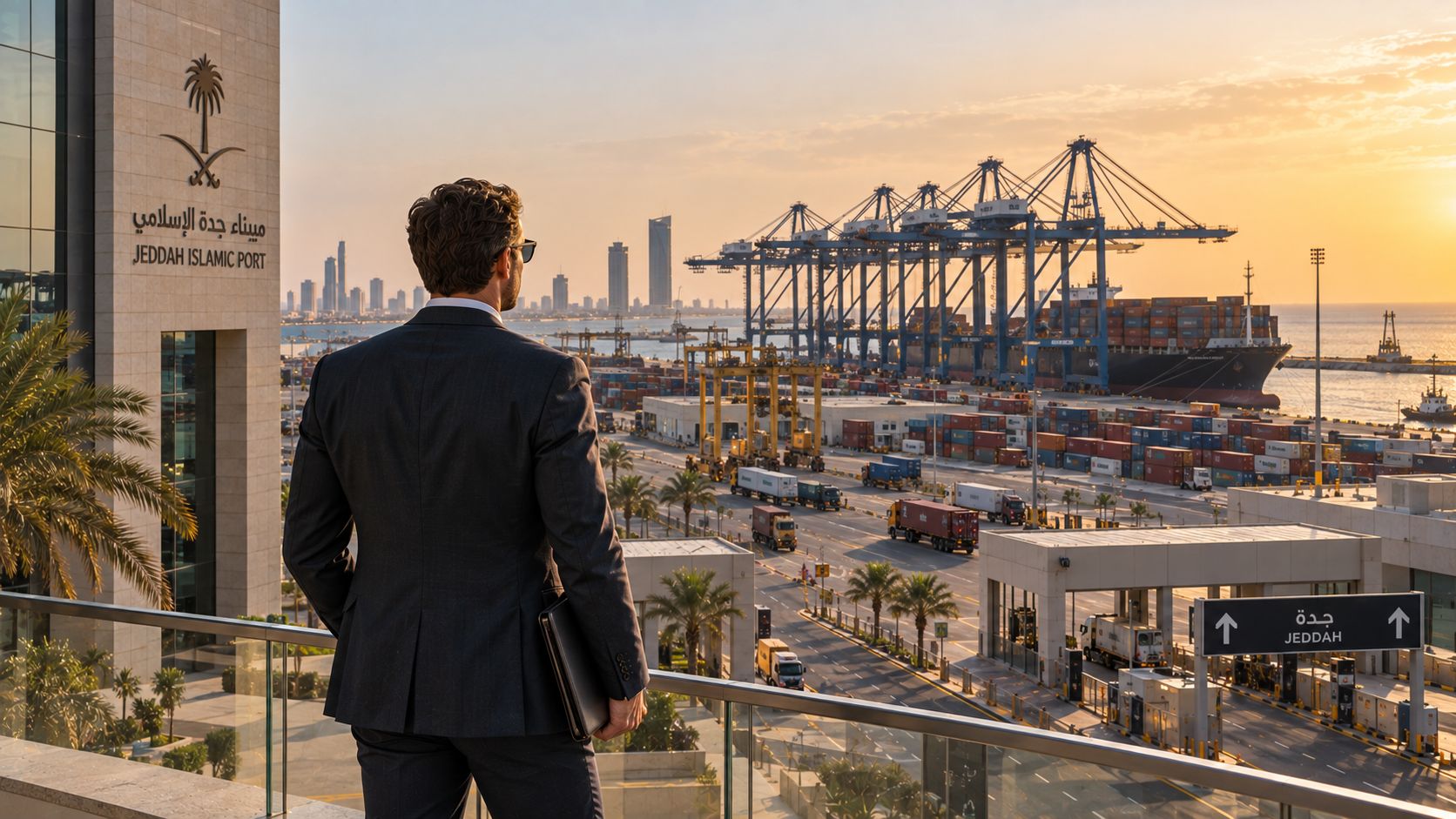
Jeddah is Saudi Arabia’s Red Sea trade gateway, built around the Jeddah Islamic Port, which makes it a natural base for import, distribution, and wholesale. A UK founder can own a Jeddah trading company outright, but full foreign ownership of a wholesale or retail trader generally needs SAR 30 million in capital. The route runs through a MISA trading registration, then Commercial Registration, capital deposit, municipal and Chamber steps, ZATCA for tax and VAT, and customs activation for imports. The company also needs a resident general manager on the ground.
Key highlights
- Jeddah suits trading because of the Jeddah Islamic Port, Western Region distribution, and proximity to the Makkah and Madinah consumer markets.
- Full foreign ownership of a wholesale or retail trading company generally requires SAR 30 million in capital, a figure under review, with a lower-capital joint-venture route as an alternative.
- Setup runs through MISA registration, Commercial Registration with the Ministry of Commerce, capital deposit, municipal and Chamber of Commerce steps, and ZATCA tax and VAT registration.
- Importers activate customs through the Fasah platform, pay customs duties on imports, and register for VAT at 15 percent once turnover passes SAR 375,000.
- MISA licence issuance and renewal fees are suspended for 2026, though other setup costs still apply.
- The King Abdullah Economic City special economic zone near Jeddah offers a lower-tax, customs-advantaged alternative for qualifying logistics and trading activity.
Short answer, a UK founder can set up a trading company in Jeddah and own it outright, provided the capital and licensing conditions are met. Jeddah’s pull is its port and its position on the Red Sea, which make it the Kingdom’s traditional import and distribution hub. The catch is the capital rule for trading, and a setup path with several moving parts. This guide covers how to set up a trading company in Jeddah, step by step, and what it costs. It is general information rather than advice. If you want it built correctly, our team can set up the Jeddah company.
Why Jeddah for trading
Jeddah is the commercial capital of the Western Region and the Kingdom’s main Red Sea gateway. The Jeddah Islamic Port is one of the busiest ports in the region and handles a large share of Saudi imports, which makes the city a natural base for anyone moving goods into the Kingdom.
Three things pull traders to Jeddah. The port gives direct access to import and re-export flows. The Western Region is a large consumer market in its own right, and the city sits close to Makkah and Madinah, which adds year-round demand tied to religious tourism. And the local logistics and warehousing base is mature, so distribution operations have the infrastructure they need.
If your model is import, warehousing, wholesale, or distribution, Jeddah is usually the stronger choice over an inland city. If your buyers are government or corporate and sit in the capital, a Riyadh base may suit better, so match the city to where your goods land and your customers are.
The trading licence and the SAR 30 million capital rule
Trading is one of the more demanding activities to own outright, so this is the first number to confront.
A foreign investor sets up through a MISA trading registration, which permits full foreign ownership of a wholesale or retail company, generally subject to SAR 30 million in capital. The threshold is set high on purpose, to ensure foreign traders enter at scale, and it is the most common barrier for smaller foreign investors. It is under review for a possible reduction, but plan around the current figure.
There is a lower-capital alternative. A joint venture with a Saudi partner allows a smaller entry, with foreign ownership capped below 100 percent and a smaller minimum investment per foreign investor, alongside Saudisation training commitments. A UK founder set on full control budgets for the SAR 30 million. One who values speed and lower capital over full ownership considers the joint-venture route. For the wider picture, see our guide to foreign ownership rules in Saudi Arabia.
☑️ Actionable Takeaway: Decide between full ownership at SAR 30 million and a lower-capital joint venture before you file, because it changes the whole structure. Our team can model both through the Saudi setup service.
The step-by-step setup
The sequence matters, because each step depends on the one before it.
- Register with MISA. Obtain the trading registration that permits foreign ownership. MISA licence issuance and renewal fees are suspended for 2026.
- Reserve the trade name and file the articles. Submit a compliant trade name and the notarised articles of association, with the office lease, to the Ministry of Commerce portal.
- Obtain the Commercial Registration. The CR is issued with your activity codes, which define what the company may trade. Since April 2026 the CR is a unified national record that no longer expires, replaced by an annual confirmation, and English trade names are allowed.
- Deposit the capital. Place the declared capital into a Saudi bank account in the company’s name.
- Complete the municipal and Chamber steps. Secure the municipal licence tied to your premises and register with the Jeddah Chamber of Commerce.
- Register with ZATCA. Obtain the tax identification number, register for VAT, and set up e-invoicing.
- Activate customs and workforce platforms. Register on the Fasah customs platform if importing, and set up GOSI, Qiwa, and Muqeem for social insurance, workforce, and residency management.
- Open the bank account and issue the general manager’s Iqama. Corporate accounts face enhanced due diligence on foreign ownership, and having the general manager’s Iqama issued first smooths the process.
☑️ Actionable Takeaway: Sequence the general manager’s Iqama and the bank account near the end, after the CR and registrations. The the resident general manager’s Iqama sets out the order in detail.
Costs to expect
Treat every figure here as indicative, because trading costs move with capital, premises, and headcount.
The capital deposit is the largest single item for a full-ownership trader, at SAR 30 million, though this is company capital rather than a fee and stays in the business. On top sit smaller government and running costs. Ministry of Commerce incorporation charges are modest, in the region of SAR 1,200 for an LLC plus a publication fee. A serviced or flexible office to satisfy the premises requirement runs roughly SAR 15,000 to SAR 25,000 a year for many activities. Each expatriate work permit carries a sovereign cost in the region of SAR 9,700 a year. MISA fees themselves are suspended for 2026.
Bank onboarding takes around two to four weeks with a complete file, and we can help open the Saudi corporate account. Document attestation, done through the Saudi embassy, is the most common source of delay. Get the paperwork legalised correctly the first time.
☑️ Actionable Takeaway: Separate the SAR 30 million capital from the running costs in your budget, since one stays in the business and the other does not. Our team can price a realistic first-year budget for your activity.
Import, customs, and VAT
A trading company that imports has extra registrations to keep live.
Importers register on the Fasah platform to clear goods through Saudi customs, and customs duties apply to imported goods, commonly at 5 percent with higher rates on some categories. VAT applies at 15 percent, and registration is mandatory once taxable turnover passes SAR 375,000. E-invoicing through ZATCA is required, so your systems need to produce compliant invoices from the start.
Get these in place before the first shipment lands. A trader that clears goods without customs and VAT set up correctly faces delays and penalties at exactly the wrong moment.
☑️ Actionable Takeaway: Stand up customs, VAT, and e-invoicing before your first import, not after. The customs, VAT, and ZATCA registration cover what a trader must keep current.
The King Abdullah Economic City alternative
Mainland is not the only route. Near Jeddah, the King Abdullah Economic City is one of the Kingdom’s special economic zones, aimed at logistics, manufacturing, and trade.
The special economic zones offer a lighter tax and customs treatment than the mainland for qualifying activities, with a reduced corporate income tax rate, customs advantages, and full foreign ownership. For a trading or logistics operation that fits the zone’s remit, this can change the numbers meaningfully compared with a mainland trading licence and its SAR 30 million capital rule. It does not suit every trader, since the zone serves defined activities, so check whether your model qualifies before assuming it is cheaper.
☑️ Actionable Takeaway: Compare a Jeddah mainland trading licence against the King Abdullah Economic City route for your specific goods. Our the King Abdullah Economic City route can run the comparison.
The UK angle
Two points matter for a founder staying in Britain.
Ownership from the UK is fine, but operation is not remote. The company needs a resident general manager to act for it, so no one can run a Jeddah trader purely from a UK desk. There is a tax edge too. Where the genuine decisions are taken in the UK, the central management and control test can pull the company into UK corporation tax alongside the Saudi charge. Profits you draw while UK resident are reportable in the UK, and the UK-Saudi treaty sets the relief. Build the Saudi and UK positions as one plan.
Setup at a glance
| STEP OR ITEM | POSITION |
|---|---|
| Ownership | Up to 100 percent foreign ownership of a trading company, generally at SAR 30 million capital |
| Lower-capital route | Joint venture with a Saudi partner, capped ownership, smaller investment |
| Licence and registration | MISA trading registration, then Commercial Registration with the Ministry of Commerce |
| MISA fees, 2026 | Issuance and renewal fees suspended |
| Municipal and Chamber | Municipal licence tied to premises, Jeddah Chamber of Commerce membership |
| Tax | 20 percent corporate income tax on foreign-owned profits, VAT 15 percent |
| Imports | Fasah customs registration, customs duties, e-invoicing |
| Resident manager | General manager with an Iqama required to act for the company |
Figures are indicative for 2026 and change. Confirm the current position with MISA, the Ministry of Commerce, and ZATCA before acting.
Frequently Asked Questions
Register a trading activity with MISA, complete Commercial Registration with the Ministry of Commerce, deposit the capital, take the municipal and Jeddah Chamber steps, register with ZATCA for tax and VAT, and activate customs if importing. A resident general manager with an Iqama is needed to act for the company.
Full foreign ownership of a wholesale or retail trading company generally requires SAR 30 million. This is company capital, not a fee, and it stays in the business. A joint venture with a Saudi partner allows a lower-capital entry with capped foreign ownership. The SAR 30 million figure is under review.
Yes, subject to the SAR 30 million capital rule for full foreign ownership of trading. You can own it from the UK without relocating, but the company needs a resident general manager on the ground to operate.
Jeddah is built around the Jeddah Islamic Port and the Western Region supply chain, which suits import, warehousing, and distribution. Riyadh suits companies whose customers are concentrated in the capital. Match the city to where goods enter and where buyers sit.
A foreign owner's share of profit is taxed at 20 percent corporate income tax. VAT sits at 15 percent, mandatory once turnover passes SAR 375,000, and imported goods attract customs duties. Dividends paid to a UK shareholder take a 5 percent withholding, reducible under the UK-Saudi treaty.
It can be for qualifying activities. The King Abdullah Economic City near Jeddah offers a reduced corporate tax rate, customs advantages, and full foreign ownership for defined activities, which can beat a mainland trading licence and its SAR 30 million capital rule. Check whether your model qualifies first.
Your next step
Setting up a trading company in Jeddah is straightforward once the capital question is settled and the steps run in the right order. Decide between full ownership at SAR 30 million and a joint-venture route, sequence the MISA, CR, and customs steps, put a resident manager in place, and handle the Saudi and UK tax together. Gatestone Group works with UK founders from offices in London and the region, sets up the Jeddah entity, and manages the licensing, customs, and tax registrations. Book a free consultation to plan the setup before you commit.
Gatestone Group is a business setup and company formation consultancy working with entrepreneurs, investors, and growing companies across Dubai, the wider UAE, Saudi Arabia, and the United Kingdom. This article was prepared and reviewed by the firm’s advisory team using current guidance from the relevant authorities.
This article provides general information about setting up a trading company in Jeddah for UK-based founders, as of 2026. Ownership rules, capital thresholds, fees, customs, and tax vary by activity and change without notice, so every figure here is indicative and should be confirmed before filing. Gatestone Group provides business setup and corporate services. We are not a law firm, a registered tax agent, an audit firm, or a licensed financial adviser, and nothing here is legal, tax, or financial advice. The requirements referenced are based on publicly available guidance from the relevant authorities, including the Ministry of Investment of Saudi Arabia and the Ministry of Commerce. Rules and figures change, so always verify the current position with those authorities, ZATCA, and Gatestone Group before acting. For personalised support setting up a trading company in Jeddah, contact Gatestone Group to arrange a consultation.