
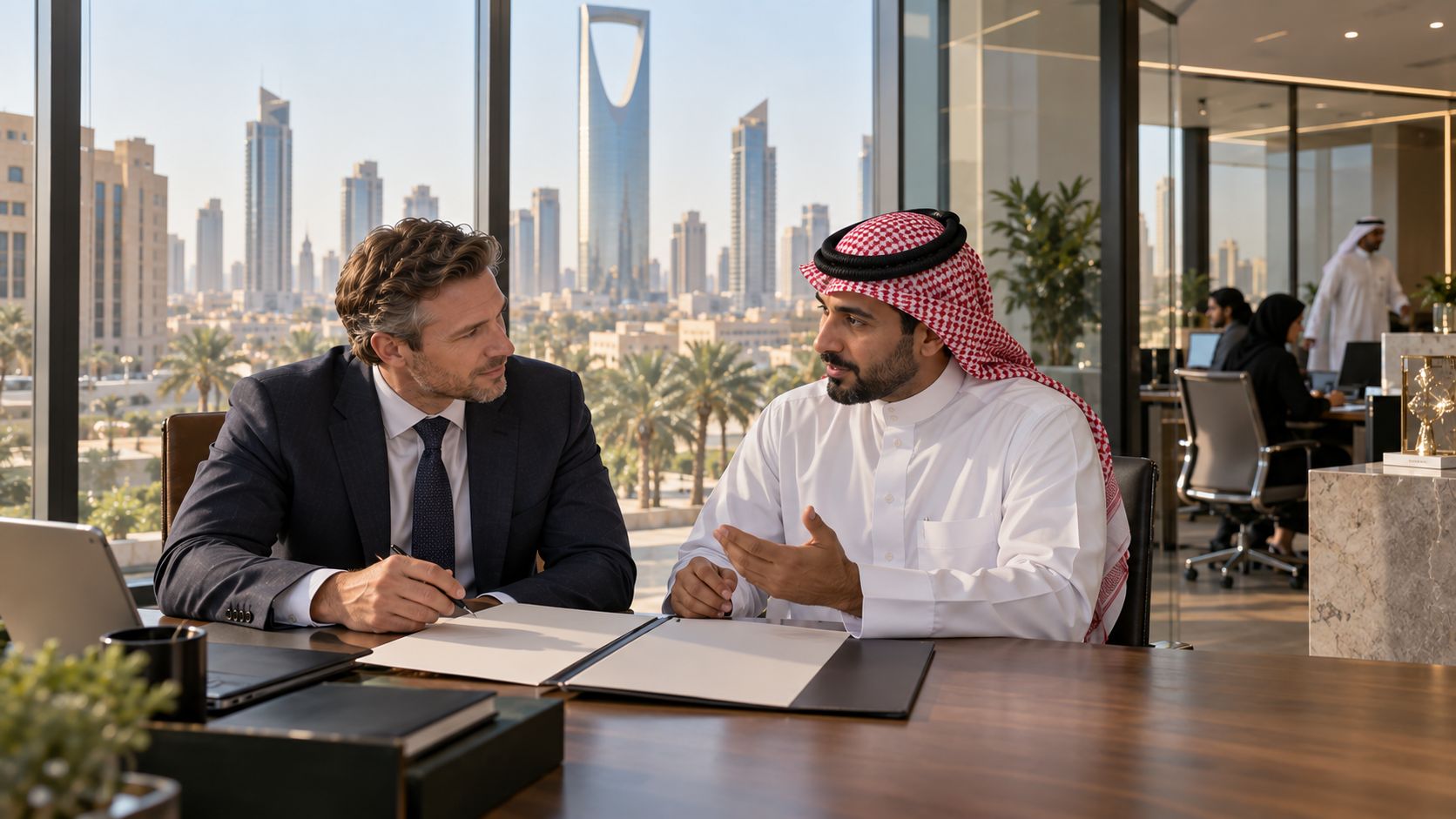
Under the 2025 Investment Law, 100 percent foreign ownership is the default in most sectors, so a UK founder can usually own a Saudi company outright with no local partner. A short negative list still blocks or restricts a few activities. Trading is the main catch, full foreign ownership of a wholesale or retail company generally needs SAR 30 million in capital. Owning the company does not let you run it from London alone, since it needs a resident general manager, and its tax follows ownership, with 20 percent corporate income tax on the foreign-owned share.
Key highlights
- Since the 2025 Investment Law, full foreign ownership is the default across most commercial, industrial, professional, and service activities, with the Saudi-partner requirement removed from most sectors.
- A short negative list of excluded or restricted activities still applies, so the specific activity must be checked against it before registering.
- Service and professional companies have no fixed statutory minimum capital. Full foreign ownership of a wholesale or retail trading company generally requires SAR 30 million, a figure under review.
- Foreign investors now register with the Ministry of Investment (MISA), and MISA licence issuance and renewal fees are suspended for 2026.
- A wholly foreign-owned Saudi company pays 20 percent corporate income tax, dividends to a UK shareholder carry a 5 percent withholding, and VAT is 15 percent.
- Owning the shares is separate from running the company, which needs a resident general manager on the ground.
Short answer, a UK founder can own most Saudi companies outright in 2026. The reform of the ownership regime has made full foreign ownership the norm rather than the exception. The detail that still matters is which activities sit outside that norm, and how much capital a trading company needs. This guide sets out the foreign ownership rules Saudi Arabia applies now, where they stop, and what a British founder should plan around. It is general information rather than advice. If you want the entity set up correctly, our team can set up the Saudi company end to end.
The rule in 2026, full ownership is the default
Saudi Arabia rewrote its foreign investment regime. Under the 2025 Investment Law, foreign investors register through the Ministry of Investment, and full foreign ownership now applies as the default position across the large majority of commercial, industrial, professional, and service activities. The old requirement to give a Saudi partner equity has been removed from most sectors.
Sectors open to 100 percent ownership include manufacturing, information technology, professional and consulting services, logistics, healthcare, construction, hospitality, education, and renewable energy. Technology and digital services face almost no ownership restrictions at all.
The process shifted too. The old foreign investment licence has moved towards a single registration, and MISA licence issuance and renewal fees are suspended for 2026, having previously run to SAR 12,000 and SAR 62,000. Registration typically takes a few business days with documents in order.
☑️ Actionable Takeaway: Confirm your activity qualifies for full ownership before anything else, because everything downstream depends on it. Our team can check eligibility as part of the Saudi setup and licensing service.
The negative list, where 100 percent stops
Full ownership is the default, not a universal right. A short negative list of excluded or restricted activities remains in force, and any business must be verified against it before registration.
The list is far shorter than it once was, but it still covers sensitive areas. Historically these have included upstream oil exploration and production, certain military and security activities, and real estate investment in Makkah and Madinah, among a small number of others. Some restricted activities are excluded from foreign investment entirely, while others allow foreign participation only up to a cap or with conditions.
Because the list changes as the Kingdom keeps opening sectors, the only safe step is to check your exact activity code against the current MISA position rather than assume. A single misclassified activity is a common reason an application stalls.
☑️ Actionable Takeaway: Verify your activity against the current negative list with MISA before filing. The government approvals and sector checks are worth checking early, not late.
Capital, the SAR 30 million trading rule
This is the point that surprises UK founders most.
There is no single minimum capital that applies to every company. Many service and professional activities carry no fixed statutory minimum, and MISA applies activity-based expectations that often sit somewhere between SAR 100,000 and SAR 500,000 depending on the sub-activity. A consulting or technology company can usually start with modest capital.
Trading is different. Full foreign ownership of a wholesale or retail company generally requires SAR 30 million in capital. The government sets it deliberately high to ensure foreign traders enter at scale, and it is the single most cited barrier for smaller foreign investors. There is a lower-capital alternative through a joint venture with a Saudi partner, where foreign ownership is capped and a smaller investment applies, and the SAR 30 million figure is under review for possible reduction. Plan around the current number, not a hoped-for cut. If trading is the plan, our guide to setting up a trading company in Jeddah walks through the capital and the steps.
☑️ Actionable Takeaway:If you plan to trade, budget for the SAR 30 million capital rule or model a joint-venture route. Our a special economic zone route can map the cheapest compliant structure for your activity.
Owning is not the same as running
Owning the shares from the UK is one thing. Operating the company is another.
A Saudi company generally needs a general manager who is resident in the Kingdom, usually holding an Iqama, to act for it before the authorities and the banks. You can own up to 100 percent from London without relocating, but the company still needs someone with authority on the ground. So a British founder either moves and takes residency, or appoints a resident general manager who genuinely runs the business.
This matters for more than admin. Where the real decisions are made affects both Saudi substance and your UK tax position, which we come to below.
Tax follows ownership
Saudi tax is decided by who owns the company, not just by what it does.
Saudi tax splits by who holds the shares. Foreign, non-GCC owners bring their portion of profit into corporate income tax at 20 percent. Saudi and GCC owners fall under Zakat at 2.5 percent of the Zakat base instead. A wholly UK-owned company therefore sits fully inside the 20 percent charge, with no Zakat element. On top of that, dividends sent to a non-resident carry a 5 percent withholding, treaty relief aside, and VAT runs at 15 percent.
☑️ Actionable Takeaway: Factor 20 percent corporate income tax and the 5 percent dividend withholding into your model from the start. Our the Saudi tax numbers can coordinate the Saudi and UK numbers.
What a UK founder should also weigh
A few 2026 points sit alongside the ownership rules.
Property rights widened. A law effective in January 2026 lets 100 percent foreign-owned private companies own real estate across the Kingdom, not only inside designated zones. Company registration also changed, with the Commercial Register now a unified national record that no longer expires, replaced by an annual confirmation, and English trade names permitted.
The UK side has not gone away. If you run the Saudi company from the UK, HMRC can treat it as UK tax resident under the central management and control test, which puts it inside UK corporation tax alongside the Saudi charge. And while you remain UK resident, dividends you draw are reportable in the UK. The UK-Saudi double taxation treaty governs relief, so plan both sides together rather than in isolation. Our guide to running a Saudi company while living in the UK covers this in full.
☑️ Actionable Takeaway:Treat ownership, Saudi tax, and your UK position as one plan. A genuine a resident presence and Iqama supports the substance both tax systems look for.
DFSA categories at a glance
| SECTOR OR ITEM | POSITION FOR A FOREIGN FOUNDER |
|---|---|
| Services, consulting, IT, professional | 100 percent ownership, no fixed statutory minimum, MISA expectations often SAR 100,000 to SAR 500,000 |
| Manufacturing, logistics, construction, healthcare, education | 100 percent ownership available |
| Wholesale and retail trading | 100 percent ownership generally requires SAR 30 million capital, under review |
| Negative list activities | Excluded or restricted, verify the exact activity with MISA |
| MISA licence fees, 2026 | Issuance and renewal fees suspended |
| Corporate income tax | 20 percent on the foreign-owned share |
| Dividend withholding | 5 percent to a non-resident, reducible under the UK-Saudi treaty |
Rules, thresholds, and fees change. Confirm the current position with MISA and ZATCA before acting.
Frequently Asked Questions
Yes, in most sectors. Under the 2025 Investment Law full foreign ownership is the default across the majority of commercial, industrial, professional, and service activities, with no Saudi partner required. Only activities on a short negative list are restricted or excluded, so verify your specific activity with MISA first.
The activity must sit outside the negative list, the investor registers with MISA, sector-specific conditions must be met, and some activities carry capital thresholds. Trading is the main one, where full foreign ownership generally needs SAR 30 million in capital.
Not a single fixed one. Many service and professional activities have no statutory minimum, though MISA applies activity-based expectations often between SAR 100,000 and SAR 500,000. Wholesale and retail trading is the exception, generally requiring SAR 30 million for full foreign ownership.
No, in most sectors. The Saudi-partner requirement has been removed from the majority of activities. A partner is only needed for certain restricted activities, or as a lower-capital route into trading where full ownership would otherwise require SAR 30 million.
Tax tracks ownership. A foreign, non-GCC owner's share of profit is charged corporate income tax at 20 percent, while a Saudi or GCC owner's share is charged Zakat at 2.5 percent instead. A wholly foreign-owned company sits entirely in the 20 percent band. Dividends to a non-resident carry a 5 percent withholding, and VAT is 15 percent.
Yes for ownership. You can hold up to 100 percent from the UK without relocating. Running the company is different, as it needs a resident general manager with an Iqama to act for it, and running it from the UK can create a UK tax exposure.
Your next step
The foreign ownership rules Saudi Arabia now applies are more open than at any point before, which makes the plan simpler for most UK founders. Check the activity against the negative list, size the capital correctly, put a resident manager in place, and handle the Saudi tax and the UK side together. Gatestone Group works with UK founders from offices in London and the region, sets up the Saudi entity, and keeps the ownership, licensing, and tax aligned. Book a free consultation to check your activity and structure before you file.
Gatestone Group is a business setup and company formation consultancy working with entrepreneurs, investors, and growing companies across Dubai, the wider UAE, Saudi Arabia, and the United Kingdom. This article was prepared and reviewed by the firm’s advisory team using current guidance from the relevant authorities.
This article provides general information about foreign ownership rules in Saudi Arabia for UK-based founders, as of 2026. Ownership eligibility, capital thresholds, tax, and the negative list vary by activity and change without notice. Gatestone Group provides business setup and corporate services. We are not a law firm, a registered tax agent, an audit firm, or a licensed financial adviser, and nothing here is legal, tax, or financial advice. The requirements referenced are based on publicly available guidance from the relevant authorities, including the Ministry of Investment of Saudi Arabia and the Zakat, Tax and Customs Authority. Rules and figures change, so always verify the current position with those authorities and with Gatestone Group before acting. For personalised support with Saudi ownership and company formation, contact Gatestone Group to arrange a consultation.