
Quick answer: A UK company can enter Saudi Arabia through a branch office or a subsidiary, usually a limited liability company (LLC). A branch is part of the UK company, so the parent carries its debts. An LLC is a separate Saudi company with limited liability. Both register with the Ministry of Investment (MISA) and pay 20% corporate income tax on foreign-owned profit, plus 5% withholding when profit goes back to the UK. (Checked November 2026.)
A branch office in Saudi Arabia suits UK companies that want to deliver contracts under their own name and track record. A subsidiary suits companies that want to ring-fence risk, bring in a Saudi partner, or grow a local business that may one day be sold. Both routes are part of business setup in Saudi Arabia for UK companies, and the choice shapes your liability, tax, hiring and exit for years.
Gatestone Group has helped with more than 865 company setups and works with UK clients from London, Dubai and Riyadh. This guide sets out the two structures side by side, then the steps, documents, capital, tax and rules that decide which one fits.
Branch office vs subsidiary at a glance
| Branch of a UK company | Saudi LLC (subsidiary) | |
|---|---|---|
| Legal status | Part of the UK company, no separate legal personality | Separate Saudi legal person |
| Liability | UK parent liable for all branch debts and contracts | Limited to the capital invested |
| Owners | UK parent only | UK parent alone (single-person LLC) or with partners |
| MISA registration | Required | Required |
| Minimum capital | Set by activity (for example SAR 30 million for fully foreign-owned trading) | Set by activity, same MISA table |
| Corporate income tax | 20% on profits | 20% on the foreign-owned share of profits |
| Tax when profit goes to the UK | 5% on profits transferred to head office | 5% on dividends |
| Saudization (Nitaqat) | Applies | Applies |
| Government contracts | Needs a group regional headquarters (RHQ), subject to exceptions | Same rule |
| Closing down | Cancel registrations; parent stays liable for debts | Formal liquidation under the Companies Law |
| Typical end-to-end timeline | 2 to 4 months | 2 to 4 months |
What is a branch office in Saudi Arabia?
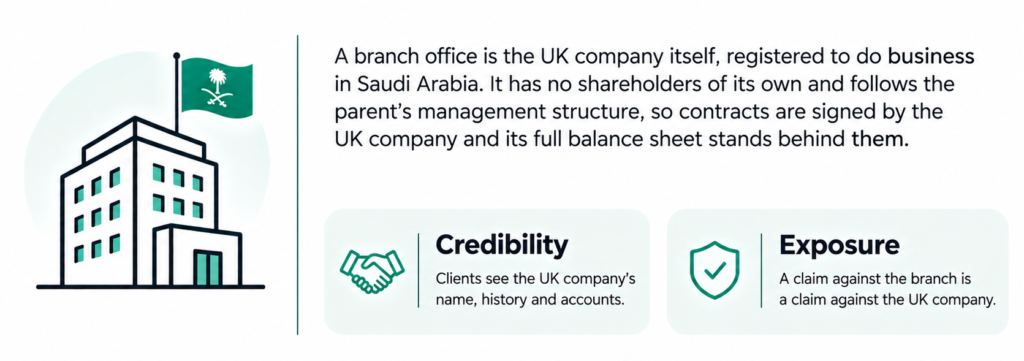
A branch office is the UK company itself, registered to do business in Saudi Arabia. It has no shareholders of its own and follows the parent’s management structure, so contracts are signed by the UK company and its full balance sheet stands behind them.
That has two effects for a UK business:
- Credibility: clients see the UK company’s name, history and accounts. This helps engineering, consulting and project firms whose prequalification depends on parent experience.
- Exposure: a claim against the branch is a claim against the UK company. If the Saudi work goes wrong, UK assets are at risk.
How do you open a foreign company branch in Saudi Arabia?
Every foreign investor, branch or subsidiary, now starts with MISA. Under the Investment Law that took effect in February 2025, the old MISA licence became an Investment Registration Certificate. Its Implementing Regulations followed in April 2025.
The usual sequence is:
The MISA Investor Guide (April 2025) asks for two core documents from the parent: its commercial register and its financial statements for the last financial year, both authenticated. Some activities have extra conditions. Recruitment, for example, needs three years of commercial registration and three years of accounts.
Saudi Arabia joined the Apostille Convention in December 2022, but MISA’s guide still refers to Saudi Embassy authentication. Confirm the current route for your documents before you send them. Our guide to Saudi business setup costs covers the UK-side legalisation fees.
What is a Saudi LLC subsidiary?
A limited liability company is a separate Saudi legal person. Under the Companies Law in force since 19 January 2023, a UK company can own an LLC on its own as a single-person LLC, and that LLC can own further companies.
A subsidiary suits UK businesses that:
- want Saudi risk kept away from the UK balance sheet
- plan to bring in a Saudi or GCC partner later
- expect to sell or list the Saudi business in future
- want to build a local brand rather than trade under the UK name
The registration path is the same as a branch: MISA, then Commercial Registration, then the Chamber, premises, tax, labour and banking. The difference is the Articles of Association for the new company, and that the LLC, not the UK parent, signs contracts.
What is the minimum capital for a branch office in Saudi Arabia?
On profits made in Saudi Arabia, the two structures land in a similar place. The Zakat, Tax and Customs Authority (ZATCA) taxes them as follows:
| Activity | Minimum capital | Saudi ownership needed | Other conditions |
|---|---|---|---|
| Trading, 100% foreign-owned | SAR 30,000,000 About £5.96 million |
None | Presence in at least 3 regional or global markets |
| Trading with a Saudi partner | SAR 26,666,667 About £5.30 million |
25% | |
| Engineering consulting, 100% foreign-owned | None stated | None | Presence in at least 4 countries and 10 or more years of experience |
| Telecoms | None stated | 40% | |
| Real estate development | Project value of SAR 30 million or more | Outside Makkah and Madinah |
For many service activities, the guide states no minimum. Older consultancy pages quote SAR 500,000 for branches, but we could not find that figure in current MISA guidance. Confirm the rule for your activity before you budget. Our guide to foreign ownership rules in Saudi Arabia explains the trading threshold in more detail.
How are a branch and a subsidiary taxed?
| Tax | Branch | LLC subsidiary |
|---|---|---|
| Corporate income tax | 20% on branch profits | 20% on the foreign-owned share |
| Zakat | Not applicable to a wholly foreign branch | 2.5% of the zakat base on any Saudi or GCC-owned share |
| Profit sent to the UK | 5% withholding on profits transferred to head office | 5% withholding on dividends |
| Royalties paid to the UK | 15% domestic rate, 8% under the UK-Saudi treaty | Same |
| Technical and consulting services paid to the UK | 5% | Same |
| Management fees paid to the UK | 20% | Same |
ZATCA’s Withholding Tax Guideline (second version, May 2026) treats profits a branch transfers to related parties as distributed profits, which is why the 5% applies. The UK-Saudi double tax convention, in force since 1 January 2009, sets dividends at 5%, interest at 0% and royalties at 8%. Treaty rates need the ZATCA treaty relief process, so plan for it before the first payment.
Two practical differences matter more than the headline rates:
- Head office charges. A branch’s ability to deduct interest and royalties paid to its own head office is limited. A subsidiary can pay its UK parent under arm’s-length agreements, subject to transfer pricing rules.
- The UK side. Branch profits are taxed in the UK unless the company makes a foreign branch exemption election. Dividends from a subsidiary are usually exempt in the UK. Take UK tax advice on both.
Which other structures can a UK company use?
Two other routes come up often:
- Regional headquarters (RHQ): a new branch or subsidiary that manages the group’s regional business. It cannot carry on commercial activity itself. Conditions include a presence in at least two countries besides Saudi Arabia and the home country, and 15 full-time staff within a year, including 3 senior executives. RHQ incentives include 0% corporate income tax on eligible income and 0% withholding on dividends for 30 years. New RHQ licensing rules were consulted on in September 2025, so check the current version.
- Technical and scientific services office: supports a foreign company’s products through a Saudi agent, for example with after-sales service. It cannot trade directly.
Can a branch win Saudi government contracts?
Not on its own. Since 1 January 2024, government entities generally cannot contract with multinational groups that have no regional headquarters in Saudi Arabia. Exceptions include:
- contracts worth up to SAR 1 million (about £199,000)
- work performed outside Saudi Arabia
- cases where only one bidder qualifies, or in an emergency
- a bid at least 25% cheaper than the next
MISA also offers a temporary registration that lets a foreign company carry out a specific government contract, ending with the contract. If public sector work is your main target, plan the RHQ question before choosing between a branch and an LLC.
Does Saudization apply to a foreign branch?
Yes. The Nitaqat programme applies to every private sector establishment, including foreign-owned branches and LLCs. Quotas depend on your sector and headcount. The Developed Nitaqat updates in May 2026 also assess establishments in the same activity together. Budget for Saudi hires, GOSI social insurance for every employee, and Qiwa labour file management from day one. Our GRO services in Saudi Arabia cover these filings.
Which structure suits which UK company?
These three scenarios are illustrative:
- A Birmingham engineering consultancy bidding for project work. Its prequalification rests on 20 years of UK project history. A branch lets it bid under its own name. It qualifies for 100% foreign ownership in engineering consulting, and it plans an RHQ review if public sector work grows.
- A Bristol software company selling subscriptions to Saudi businesses. It wants a local sales team and may take a Saudi investor later. A single-person LLC keeps risk in Saudi Arabia and leaves room for a partner.
- A London facilities management group with several Gulf contracts. It already runs a Dubai company. It weighs a Saudi LLC owned by the UAE company against a direct UK-owned branch, with tax advice on both routes.
How long does each structure take, and what does it cost?
MISA’s own estimate for investment registration is about 10 working days. The full sequence, from UK documents to an open bank account, typically takes 2 to 4 months for either structure. Published consultancy prices vary widely: VJM Global quotes SAR 20,000 to 50,000 for setup consulting, and Analytix puts government fees at about SAR 7,700 to 15,200. These figures are indicative and vary by activity, visas and office space. Our Saudi Arabia business setup cost guide itemises first-year costs in pounds and riyals.
Closing a branch vs closing an LLC
A branch closes by cancellation. You obtain endorsement letters, cancel the Commercial Registration, close the ZATCA number, clear employees and premises, and settle obligations. MISA then issues its cancellation decision within 2 working days, with no MISA fee. The UK parent remains liable for any branch debts.
An LLC must also go through formal liquidation under the Companies Law. That means appointing a liquidator, notifying creditors and preparing final accounts. It takes longer, but the UK parent’s exposure stays limited to its capital.
“Most UK companies come to us asking for a branch because it feels simpler. Often it is the right answer, especially for consultancies whose UK track record wins the work. But if Saudi Arabia will become a business in its own right, with local staff, local partners or government clients, we usually recommend an LLC from the start, because changing structure later costs more than choosing well now.”
— Rehan Abid,
Senior Market Entry Consultant and Managing Director UAE, Gatestone Group
How Gatestone Group helps
From our London office, we prepare and legalise your UK documents. Our Riyadh team then handles the MISA registration, Commercial Registration, premises, ZATCA, GOSI and Qiwa filings, and the bank account. We can also bring in tax specialists for the UK and Saudi structuring questions. Ask our Riyadh team which structure fits your plans.
Frequently Asked Questions
Can a foreign company open a branch in Saudi Arabia?
Yes. A UK company can register a branch with the Ministry of Investment (MISA) and then obtain a Commercial Registration from the Ministry of Commerce. The branch is part of the UK company, so the parent is liable for its debts.
What is the difference between a branch and an LLC in Saudi Arabia?
A branch is an extension of the UK parent with no separate legal personality, so the parent carries its liabilities. An LLC is a separate Saudi company, and the UK shareholder’s liability is limited to the capital it puts in.
How long does it take to open a branch office in Saudi Arabia?
MISA estimates about 10 working days for investment registration once documents are complete. The full process, including Commercial Registration, municipal licence, tax, labour registrations and a bank account, typically takes 2 to 4 months.
What is the minimum capital for a branch in Saudi Arabia?
MISA sets minimum capital by activity rather than by structure. Fully foreign-owned trading needs SAR 30 million (about £5.96 million). Many service activities have no minimum stated in the MISA Investor Guide, but check your activity before you apply.
How is a branch taxed in Saudi Arabia?
A branch owned by a UK company pays 20% corporate income tax on its profits. Profits transferred to the UK head office are treated as distributed profits and are subject to 5% withholding tax under ZATCA guidance.
Can a branch bid for Saudi government contracts?
Since 1 January 2024, multinational groups without a regional headquarters in Saudi Arabia are generally barred from government contracts, with exceptions such as contracts up to SAR 1 million. A branch alone does not meet the rule.