
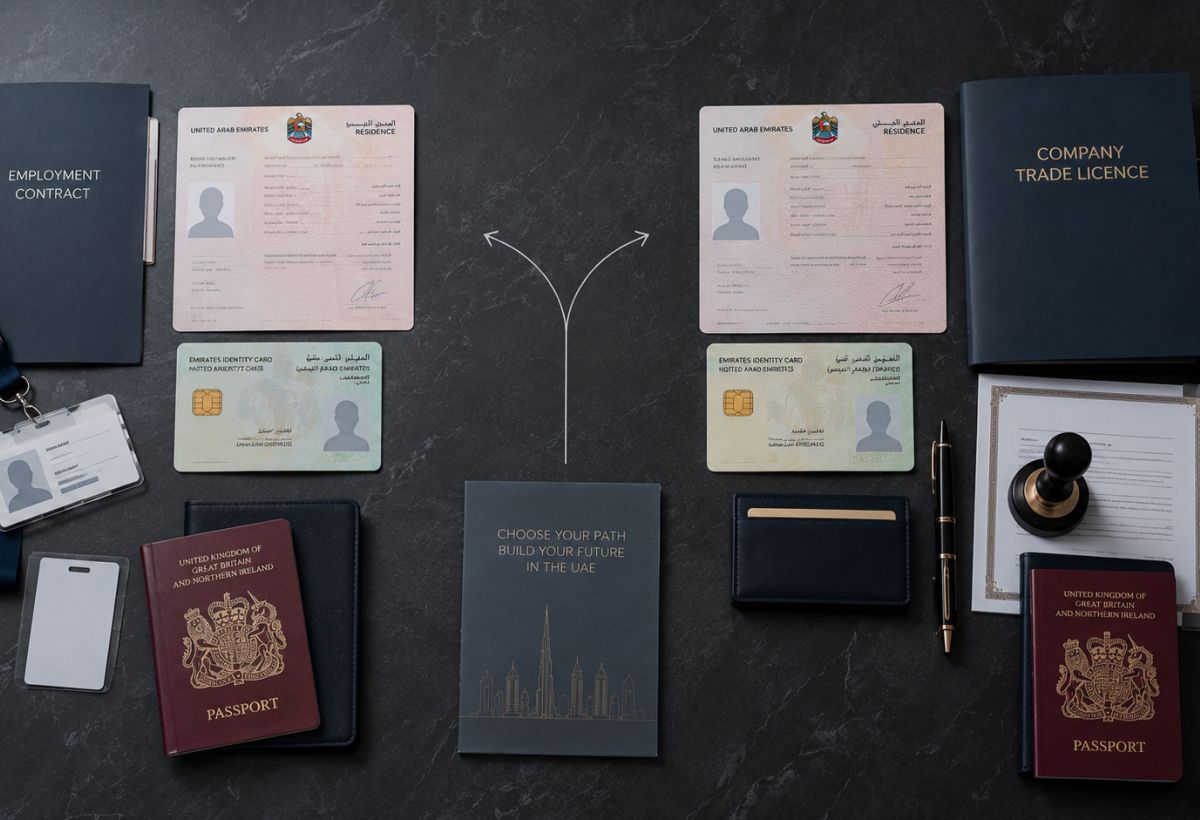
Two founders relocate to Dubai in the same month. One holds an employment visa sponsored by a company. The other holds an investor visa through a company she owns. On paper both are UAE residents with an Emirates ID. In practice their positions are very different.
The UAE employment visa vs investor visa question comes down to who controls your residency. That single difference affects your banking, your exit options, and what happens if the business changes.
This guide compares both routes for a UK founder. If you want the company and visa structured together, see our business setup in Dubai service.
What each visa actually is
An employment visa is sponsored by a UAE employer. The company holds the sponsorship, applies under its own visa quota, and the visa is tied to that employment relationship. It comes with a labour contract registered with the Ministry of Human Resources and Emiratisation for mainland roles, or with the relevant free zone authority.
An investor or partner visa is tied to ownership. When you set up a UAE company, the licence carries a visa quota, and as the owner you apply under that quota. The sponsor is effectively your own company. It is usually valid for two to three years, renewable while you retain ownership.
There is a third route worth naming. The Golden Visa runs five or ten years and requires larger qualifying investment or status, covered in our guide to the Golden Visa for business owners.
Side-by-side comparison
| FACTOR | EMPLOYMENT VISA | INVESTOR OR PARTNER VISA |
|---|---|---|
| Sponsor | Your employer | Your own company |
| Basis | Employment contract | Ownership or shareholding in a UAE company |
| Typical validity | Tied to the contract, commonly two years | Usually two to three years, renewable |
| Who controls it | The employer | You |
| If the relationship ends | Visa is cancelled, with a grace period to exit or transfer | Continues while you retain ownership of the company |
| Requires you to set up a company | No | Yes |
| Upfront cost | Usually borne by the employer | Licence plus visa, roughly AED 12,000 to AED 20,000 first year in a free zone |
| Labour law protection | Covered by UAE labour law, including end-of-service benefits | Not an employee, so labour law protections do not apply in the same way |
| Family sponsorship | Possible, subject to salary and accommodation conditions | Possible once your own visa is active |
| Banking | Personal account straightforward, corporate account depends on the company | Personal and corporate account both accessible, and preferred by most banks |
Figures are indicative for 2026 and vary by free zone, activity, and package.
The control question
This is the difference that matters most for a founder.
On an employment visa, your residency depends on someone else’s decision. If the employer terminates the contract, restructures, or lets the trade licence lapse, your visa goes with it. You get a grace period to leave or transfer sponsorship, but the timing is not yours.
On an investor visa, your residency depends on your own company remaining in good standing. You control renewals, you control whether the licence stays active, and you are not exposed to an employer’s decisions.
For a founder building something, that control is usually worth the cost of setting up the entity.
The cost comparison is misleading
An employment visa looks cheaper because the employer normally pays. UAE labour rules place the cost of employment visa processing on the employer rather than the employee for mainland roles.
An investor visa requires you to set up a company first, so you carry the licence cost. In a Dubai free zone, a solo setup with one visa realistically runs around AED 12,000 to AED 20,000 in the first year, covering the licence, a flexi-desk, registration, and the visa itself. The residence visa component alone is roughly AED 3,000 to AED 6,000 per person including the medical test, Emirates ID, and stamping.
The comparison is misleading because the two routes buy different things. The employment visa buys residency. The investor visa buys residency plus a trading entity, a corporate bank account, and the ability to invoice clients. If you were going to set up a company anyway, the visa is close to a marginal cost. Our full breakdown sits in the business setup cost in Dubai guide.
Banking
Most tier one UAE banks expect at least one shareholder or authorised signatory to hold a valid UAE residence visa and Emirates ID before opening a corporate account. That requirement flows from anti-money laundering identity verification rules rather than bank preference.
An investor visa satisfies this directly, because the visa holder is also the shareholder. An employment visa gives you an Emirates ID and easy personal banking, but it does nothing for a company you do not own.
If corporate banking is on your critical path, the investor route removes a dependency.
Labour law and end of service
One point runs in the employment visa’s favour.
An employee is covered by UAE labour law, including notice periods, leave entitlements, and end-of-service gratuity. A company owner on an investor visa is not an employee of their own company in the same sense, so those protections and entitlements do not apply in the same way.
For a founder that rarely matters. For someone taking a senior role in an established business, it can matter a great deal.
Which route fits which UK founder
If you are launching your own consultancy, agency, trading business, or ecommerce brand, the investor visa is the natural route because you need the company anyway.
If you are joining an existing UAE business as a senior hire, an employment visa is simpler and cheaper, and it carries labour protections. The executive route to a Golden Visa is also available at higher salary thresholds.
If you want long-term residence without renewing every two to three years, and you meet the investment thresholds, the Golden Visa is the stronger option.
If you are testing the market before committing, note that you do not need any residence visa to own a UAE company. Company registration does not require residency. The visa is what unlocks the Emirates ID and easier banking.
The UK tax point neither visa solves
A UAE residence visa, of either type, does not change your UK tax residency. HMRC applies the Statutory Residence Test to your personal circumstances, and a visa is not evidence of tax residence.
If you intend to become UAE tax resident, that is a separate determination requiring a Tax Residency Certificate from the Federal Tax Authority, generally based on spending more than 183 days in the UAE with supporting evidence.
Frequently Asked Questions
An employment visa is sponsored by an employer and tied to a labour contract. An investor or partner visa is tied to your ownership of a UAE company, so your own company is effectively the sponsor and you control renewals.
For someone building their own business, the investor visa is usually better because it gives control over residency and comes with the trading entity and corporate banking access. An employment visa suits senior hires joining an existing UAE company.
The company-based investor visa requires ownership of a UAE company. There is a separate property-based investor visa tied to UAE property ownership, and the Golden Visa has its own qualifying routes.
An employment visa is cancelled when employment ends, with a grace period to exit or transfer sponsorship. An investor visa depends on your company remaining in good standing, so letting the licence lapse ends the basis for the visa.
No. A residence visa and tax residence are different. UAE tax residence requires meeting the statutory criteria and obtaining a Tax Residency Certificate from the Federal Tax Authority.
Structure the company and visa together
The UAE employment visa vs investor visa choice usually resolves itself once you decide whether you are building a business or joining one, and the mistake is treating the visa as a separate decision from the company. Gatestone Group sets up the entity, secures the visa quota, and handles the Emirates ID and banking introductions in one sequence. Book a free consultation to work out which route fits.
Disclaimer
This article is general information for UK founders considering business setup and residency in the UAE. It is not legal, tax, or immigration advice. Visa categories, fees, thresholds, and rules are indicative for 2026 and change without notice. Confirm current requirements with ICP, GDRFA, the relevant free zone authority, or a Gatestone Group consultant before acting. Gatestone Group does not guarantee approvals, timelines, or specific outcomes.